Peptide Purity & Quantitation Testing
Peptide Purity Analysis Solution
The friend page on why 99 percent purity issues discusses why tiny pollutant percents can still matter in sensitive in-vitro assays. Along with this peptide testing guide, those pages develop the trust-methodology layer behind the product catalog. Peptide screening is effective, yet scientists ought to check out the scope of each method very carefully.What Is Research Laboratory Recognition And Why Is It Important For Peptides?
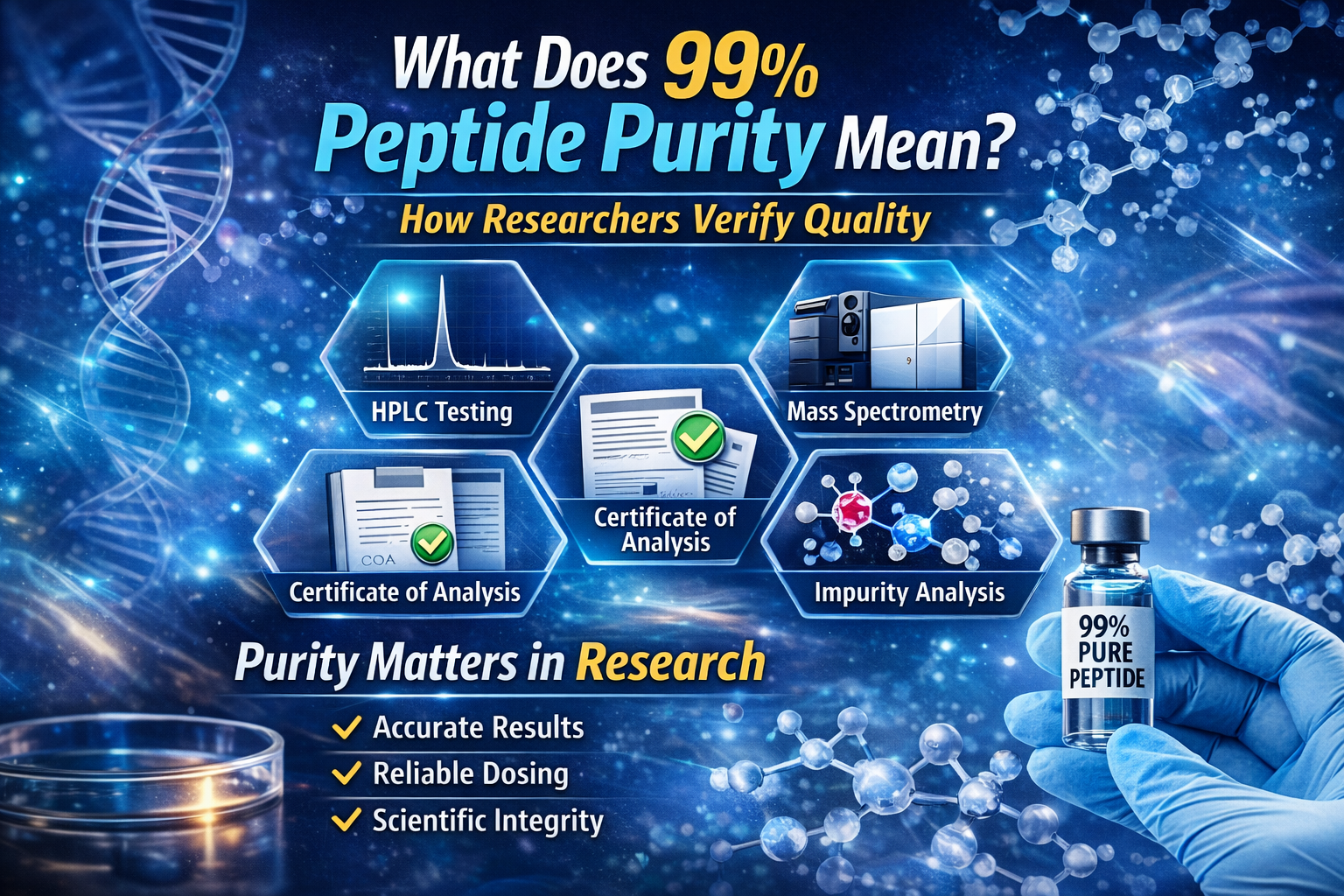
Other techniques like electrophoresis, capillary electrophoresis (CE), and nuclear magnetic vibration (NMR) can likewise be utilized to evaluate peptide structure, cost, and purity, guaranteeing extensive characterization. In COA evaluation, it normally consists of HPLC pureness screening, mass spectrometry identification confirmation, and batch-specific paperwork revealing the evaluated great deal, method, results, and date. For peptide pureness Get more information screening, reverse-phase HPLC is the conventional theoretical design. The chromatographic pureness is after that determined by comparing the location under the primary height with the total area under all incorporated heights.- As an example, capillary electrophoresis can be utilized to divide really hydrophilic peptides or to confirm results, and MALDI-TOF mass spectrometry can aid in mapping larger or changed peptides.
- We supply peptide identification confirmation utilizing mass-based techniques chosen for the example and analytical objective.
- These peptides feature a fundamental quality assurance plan, typically consisting of HPLC purity analysis and MS verification of identification, guaranteeing they fulfill clinical requirements for pureness and structure.
- Importantly, purity percentages define chemical structure only-- they do not show sterility or organic viability.
- " Mass spectrometry solutions "is the found substance regular with the intended peptide identification?
What The Impurities In Fact Are
BOC Sciences supplies multi-batch contrast evaluation to aid customers establish resources top quality requirements and make sure uniformity. Residual non-peptide parts can transform assay analysis, misshape peptide material calculations, and complicate lot credentials. We sustain targeted analysis of appropriate residuals based on the project and sample background.
Straight from the synthesizer with minimal processing-- generally simply cleavage from the resin and rainfall. Pureness ranges commonly, from 40% to 80%+ relying on series size and difficulty. Unrefined peptides are suitable for applications where purity isn't crucial, such as antibody manufacturing or preliminary testing assays where the target peptide simply needs to be present, not dominant. Carefully related to truncations, deletion peptides are unabridged chains that are missing one amino acid somewhere in the middle. If covering isn't flawlessly effective, an uncoupled chain can remain to extend in subsequent steps, creating a peptide that's just one residue except the target.High-performance Fluid Chromatography